Pre-School Program
Pre-School Program
(3–4 Years)
According to early childhood brain research, the preschool years are a powerful period of growth and discovery. Children at this age are eager to learn about themselves, others, and the world around them.
Often known as the “why” phase, preschoolers ask thoughtful questions as they absorb new information and begin making meaningful connections. Their curiosity drives deeper thinking, problem-solving, and early academic growth. The Learn ‘N’ Grow Preschool Program in Frisco is thoughtfully designed to channel this energy into purposeful learning experiences. Our teachers guide children’s thinking through intentional play, meaningful discussions, and structured instruction that supports school readiness.
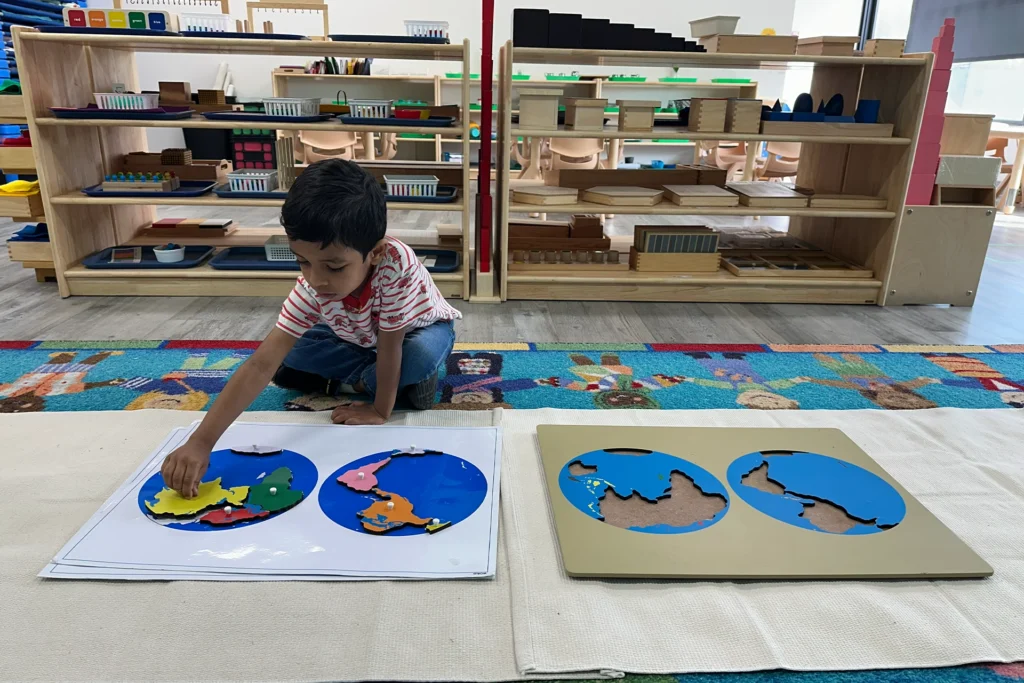
Our preschool program provides families with confidence in every aspect of their child’s development. Through engaging daily activities, our trained preschool teachers build upon existing knowledge, strengthen foundational academic skills, and prepare children for long-term success in kindergarten and beyond. As a Montessori preschool in Frisco, Learn ‘N’ Grow encourages curiosity, independence, and hands-on learning throughout the early years.
Pre-School Curriculum
During the preschool years, children naturally transition from parallel play to more interactive
and cooperative play. Our engaging curriculum is thoughtfully designed to support growth in five
key areas of development.
Literacy Development
Early language and literacy skills are essential during the preschool years. Through story time, phonics, early writing activities, and even introductory sign language, our teachers foster a love of reading while building the foundational skills needed for kindergarten readiness.
Physical Development
Active children develop healthy habits early. Our teachers incorporate movement, balance, and outdoor play into daily routines, encouraging coordination and gross motor growth. Activities on our age-appropriate playground strengthen physical skills while preparing children for the more structured movement experiences of Pre-K.
Creativity & STEM
Our Preschool Program incorporates engaging STEM experiences that spark curiosity and innovation. Through hands-on activities, imaginative exploration, and age-appropriate problem-solving challenges, children strengthen cognitive skills and develop confidence in their ability to think, create, and discover. These early STEM foundations support long-term success in school and beyond.
Social Development
Social-emotional skills are strong predictors of long-term success. Our balanced curriculum builds character, confidence, and emotional awareness while helping children develop cooperation, empathy, and problem-solving skills they will use throughout life.
Math Development
Early math experiences help preschoolers build logical reasoning and essential problem-solving skills. Our foundational math curriculum introduces patterns, sequencing, numeration, and one-to-one correspondence — all key concepts that strengthen critical thinking and prepare children for future academic success.
Pre-School Program FAQs
What age group is the Preschool Program for?
The Preschool Program serves children ages 3 to 4 years old. It focuses on fostering curiosity,
creativity, and social growth through individualized learning, intentional play, and teacher-guided
exploration in a welcoming and supportive environment.
What is the primary focus of the Preschool Curriculum?
The Preschool Curriculum focuses on developing social, emotional, cognitive, and physical
skills while promoting independence and problem-solving. Through intentional activities and
engaging STEM learning experiences, children build strong foundations for academic readiness
and future success.
How does the Preschool program promote physical development?
Through active play, outdoor games, and movement-based learning, children strengthen
coordination, balance, and motor skills. These experiences encourage healthy habits, build
confidence, and foster positive social interaction with peers.
In what ways are language and literacy supported in Preschool?
Our teachers support language and literacy through storytelling, vocabulary-building activities,
and small- and large-group discussions. These experiences strengthen communication skills,
comprehension, and early reading development.
What is the role of math in the preschool curriculum?
Math introduces foundational concepts such as patterns, sequencing, and numeration that
strengthen logical thinking. These skills help children understand relationships, recognize
structure, and develop problem-solving abilities connected to everyday experiences.
How does STEM education benefit preschoolers?
STEM activities encourage curiosity, hands-on learning, and creativity. Through exploration and
problem-solving, children strengthen cognitive skills and critical thinking, building a strong
foundation for future academic success.
How do teachers support emotional and social growth?
Teachers create a nurturing environment that fosters empathy, cooperation, and confidence.
Through guided interactions and positive reinforcement, children learn to build friendships,
share experiences, and manage their emotions in healthy ways.
What distinguishes Preschool from Pre-K programs?
Preschool serves children ages 3 to 4 and emphasizes learning through play while supporting
social and emotional development. Pre-K is designed for children ages 4 to 5 and offers a more
structured academic environment focused on literacy, numeracy, and kindergarten readiness.
What advantages does preschool education provide to Pre-K learning?
Preschool education builds a strong foundation in language, cognitive, and social skills that
supports a smooth transition into Pre-K. It fosters curiosity, problem-solving, and independence
— essential skills that prepare children for a more structured, academically focused learning
environment.