Structured activities during the preschool years play an important role in child development. These experiences encourage curiosity, help build essential skills, and introduce children to learning concepts through hands-on engagement.
Well-designed activities support cognitive development, social interaction, and emotional awareness. The selection of activities for preschoolers depends greatly on their age too.
Between the ages of 3 and 5, children are most likely to enjoy participating in a series of brief, hands-on activity-based lessons that reflect their developing motor skills and attention span.
Here, let’s deep dive into the concept of how early childhood activities help children learn, play and grow parallelly.
Integrating Learning Into Daily Activities
Early childhood or Preschool activities typically include an educational component combined with active play.
- Incorporation of play in learning helps young children to discover the surrounding world while also acquiring new skills and information when they create, explore, and interact with their surroundings.
- The combined approach to play and learning allows young children to engage and retain information more effectively.
For example: By incorporating counting into everyday events such as snack time, preschool educators create an opportunity for preschoolers to develop math concepts in an age-appropriate manner.
Key Skill Areas in Preschool Activities
Play is an important way for children to learn basic math. Kids build the foundation for math skill development through activities like block building, arts and crafts, outdoor play, and activities using sensory input.
-
Early Math Experiences
Math experiences through hands-on activities help children make a connection between numbers and quantities.
For example; sorting many objects (by size, color, etc.) as well as counting everyday items are a start in helping children develop an understanding of math concepts. These types of math activities for preschoolers also develop early number sense and logical reasoning.
-
Creative Expression Through Art
Art activities are a great way for kids to express themselves creatively and use their developing fine motor skills.
For example; Finger painting, drawing, and collage helps your kid learn how to manipulate different types of materials. Also, Preschool art activities help children develop their hand-eye coordination.
-
Physical Development Through Active Play
Physical health as well as cognitive development are both supported by having outdoor experiences. Allowing timed outdoor play activities for preschoolers can greatly improve their mood and focus when compared to indoor play.
For example; Active play such as running, jumping, and climbing enables preschoolers to develop greater physical strength, coordination, and self-confidence through the successful completion of more complex tasks.
-
Learning Through Block Play
Block play activities for preschoolers help in many different ways. By using blocks to create different structures (stacked, arranged) preschoolers can begin to understand fundamental properties of balance, stability, and spatial relationships; additionally, children develop their ability to plan and solve problems.
-
Sensory Activities for Brain Development
Sensory play activities for preschoolers engage multiple senses and support neural development.
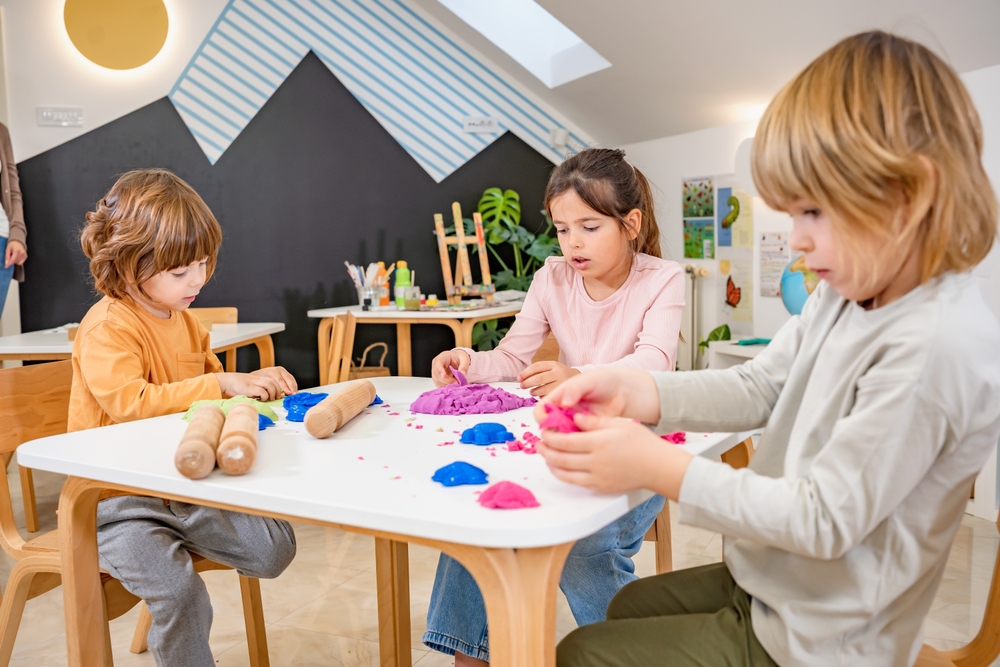
For example; activities involving materials like sand, water, playdough, or textured objects provide tactile stimulation and can help children explore cause and effect. These activities can also support emotional development. Hands-on sensory experiences may help some children process emotions and develop self-awareness.
-
Social Development Through Group Activities
Group engagement creates opportunities for developing social abilities while connecting with other students through similar experiences. Group activities promote collaboration; kids will learn the importance of sharing, taking turns, and working cooperatively with others from their experiences with partner building projects, circle games, etc.
These small groups offer children opportunities to build friendships and learn how to successfully interact socially. Adults can model appropriate social skills and assist children in developing and honing their social skills, such as problem-solving and the formation of positive relationship skills, throughout all of the group activities.
Conclusion
Consistent participation in varied childhood or preschool activities has been associated with growth in areas such as confidence, language development, and social skills. These experiences contribute to school readiness and continued learning.
Programs that incorporate math, art, sensory, outdoor, block, and cooperative play activities for preschoolers into their curriculum provide children with diverse learning opportunities.
Learn N Grow STEM Preschool also brings these preschool activities to life daily. Contact us and ask how we help your kid grow 360 degree!
Frequently Asked Questions
- Why are structured activities important during the preschool years?
Structured activities during 3 to 5 years of age help develop thinking skills, social abilities, and emotional awareness while sparking their natural curiosity and getting them ready for school.
- How do preschool activities integrate learning into daily routines?
Preschool activities blend learning with play like counting snacks, sharing stories in a circle, building with blocks, etc. Kids pick up math, language, and problem-solving naturally while having fun.
- What key developmental areas do preschool activities support?
Good preschool activities build language, early math, problem-solving, social skills, emotional understanding, and both small & large muscle control through stories, art, building, sensory play, and outdoor time.
- How do sensory and block play benefit young children?
Playing with sand, water, and playdough engages the senses, supports brain growth, and helps kids work through feelings. Building with blocks teaches balance, space, planning, and creative thinking.
If you’re looking for a unique puzzle experience, you’ve found it! The core mechanic of telekinesis attack is incredibly satisfying, offering a fresh challenge with its physics-based gameplay. It’s a clever and engaging title that will keep you thinking.
Interesting read! Balancing risk & reward is key in poker, much like choosing deposit methods. JLJL77 offers options like GCash-convenient! Considering a quick signup via jljl77 app download to explore their games. Solid platform security is a must, too.
https://shorturl.fm/ic7ro
Great atmosphere and the games are very fair. I’ve recommended this place to a few friends already because it is just that good. idhantuslot
No lag, no crashes, just pure gaming. I appreciate how stable the login process is, makes the whole experience way better.
Simple and straightforward. I dont like complicated sites, and this one gets right to the point. Fast loading and great games.